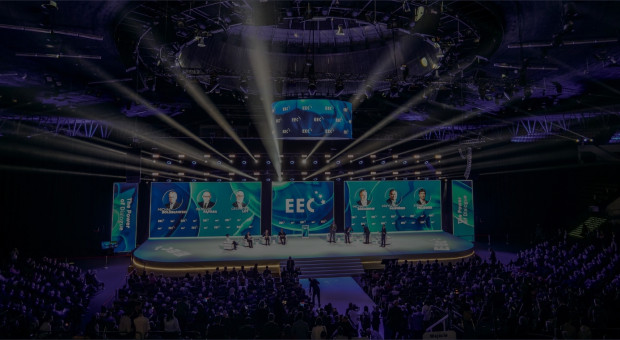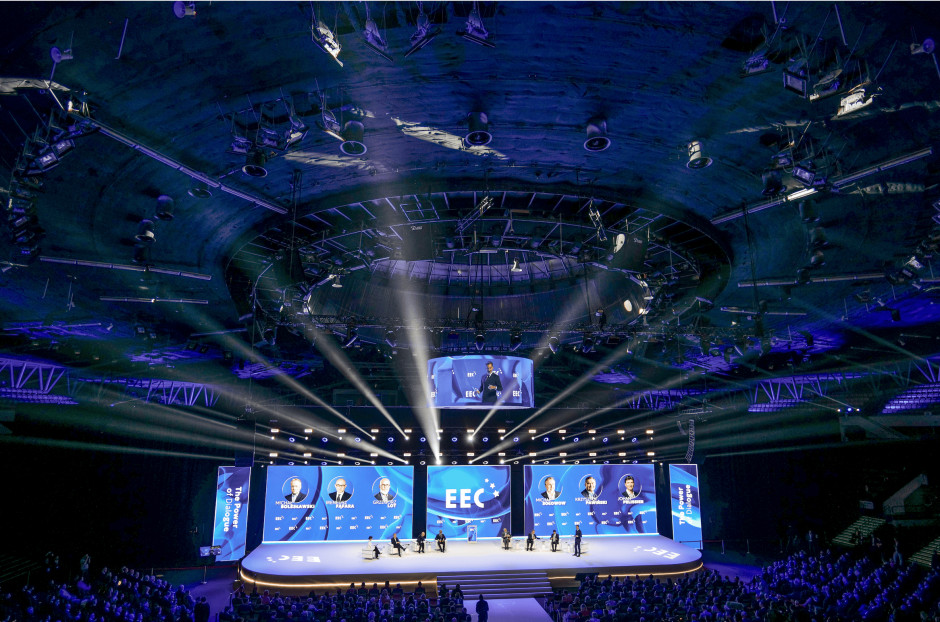
Katowice became a meeting place for representatives of global corporations, largest Polish and European companies, state-owned companies, innovative and rapidly developing SMEs, as well as promising startups. It is tradition that the European Economic Congress facilitates dialogue between businesses with decision-makers, representatives of government – both central and local – researchers, and journalists. The quality of this year’s edition of the EEC was guaranteed by over 1,350 speakers, who contributed to as many as 19 thematic blocks devoted to the most important subjects of today. During each of the discussions, the congress – in line with its main theme the Power of Dialogue – highlighted the vital importance of conversation open to a variety of opinions that enables security and resilience.
“18 years ago, when the idea of the congress was born, we were led by a vision of independent debate on Europe, economy, and smart growth. Our mission has remained unchanged, therefore the agenda of each edition is a product of many months of broad consultation in a forum of the Programme Council, during meetings of EEC Members, among partners and thousands of people creating the community of the congress,” said Wojciech Kuśpik, president of the PTWP Group, organiser and initiator of the European Economic Congress, in his opening address. “Alone, we are unable to see the future order, but together we can tackle the challenges that lie ahead. Every year, thousands of smart, energetic and influential people determine the quality of dialogue at the European Economic congress. We will make sure that your voice is heard and that Katowice once again becomes the beating heart of European economy,” he went on to add.
“Our world has come to an end. It is the end of the extraordinary peace dividend. The era of order is far behind us. We need to learn how to live in a world governed by chaos,” said Jerzy Buzek, former prime minister of the Republic of Poland and president of the Programme Council of the EEC, in his speech during the opening session. He argued that Europe – against the backdrop of chaos the world has slided into – does not look all that bad, while its strong position in a united Europe provides Poland with security and agency, e.g. in terms of new, broad agreements.
“Increasing the strength of every country, every member state of the EU, in agreement and community, should be common practice. Undoubtedly, Poland has become a leading example of this approach,” he observed. He also said that Europe needs to stand on its own feet. “We need to find a way of becoming independent, without compromising our relationship with the US, as it would be too risky. Therefore “resilience” is the key word for the next few years. We can achieve it through the power of dialogue and multilateral agreements. We need to start from our congress, like many times before,” insisted the president of the Programme Council of the EEC.
About Geopolitics and Energy Transition
The first of discussions held within the opening session of this year’s edition of the EEC concerned security, geopolitics, energy, and transition. The participants argued that energy security is key, equal in importance to military security. “Increasing its resilience, also in terms of energy, is the only path to Europe’s development. It is critical that we are resilient to what may come. Europe does not have many energy resources and those it has are enormously expensive,” said Ireneusz Fąfara, president of the management board at Grupa Orlen, insisting that Europe needs to develop alternative sources so that fuels cannot be used as a weapon against it.
“The security of the energy system is a pillar of state security in general,” added Grzegorz Lot, president of the management board at Grupa Tauron. He also said – being aware of what is possible – that currently there are no threats to electricity supply in Poland. He also pointed to the necessity of creating energy storage systems that can be used when needed. “We will still need conventional energy in the mix, but the faster we invest in alternative sources of energy, system flexibility, and gas generation, the better,” he argued.
According to Michał Bolesławski, president of ING Bank Śląski, the conflict in the Persian Gulf will contribute to deglobalisation. "It will bring business and industry to countries that are closer to the client’s needs. If the EU wants to be safe, it needs its own industry and products,” he said.
The panellists argued that these ambitions cannot be fulfilled without a good energy mix based on stable sources of energy, thus highlighting the significance of nuclear power. “Energy should be green and cheap,” they observed.
The second discussion in the opening session concentrated on reindustrialisation and building Europe’s competitive advantage.
Johan Pelissier, President of Region Europe at Airbus, talked about important changes taking place in Europe due to geopolitical turmoil. He pointed at Europe's activity in the security sector, joint purchasing commitment and directing purchasing to Europe's internal market. “This will allow European companies to grow. Together, they will build Europe’s sovereignty,” he concluded.
Krzysztof Pawiński, president of the management board at Grupa Maspex argued that prosperity is a result of thousands, if not millions, of small decisions made by businesses that are later appreciated by consumers. “It is worth talking to business as there are still low-hanging fruits waiting to be picked,” he claimed. He also mentioned the key factors determining current conditions of economic growth. In his opinion, these include rational migration policy, energy prices decreasing as a result of energy transition, and consistent deregulation.
Michał Sołowow, owner of Synthos, provided the example of Switzerland when he talked about the need to appreciate Polish entrepreneurs. He praised them for their contribution to Poland's GDP, suggesting that apart from promoting “brand Poland” we should also promote “bran entrepreneur”. “We produce 67% of Poland's GDP and yet we go virtually unnoticed. We demand a fundamental change in the energy mix, there can be no growth without it. We earn more, enjoy a better life, but we are losing our competitive edge,” he continued. He also advocated for nuclear power – precisely in the form of small modular reactors – to be the foundation of Poland’s energy transition, The entrepreneur also warned of the threat of over-scaling investments in renewable energy sources. He mentioned their low level of utilisation and the risk of dependence on gas imports linked to investing in gas generators as a system stabilizer and transition technology between coal and atom.
Another element of the opening session was an interview with minister of finance and economy Andrzej Domański. “Thank you for inviting me to what is without a doubt the most important economic event of the year,” said the minister. In his speech, he mentioned Poland being among the world’s largest 20 economic, a symbol of success of all Polish people. “Being a member of G20, Poland has been recognized as a strong and large economy. It means that we are no longer a spectator but a player determining the direction of global change,” he insisted. He also argued that, since it is not possible for Poland to impact global events, the country should concentrate on making its economy more competitive. “Energy prices are absolutely critical in this context. This is why Poland has become the largest site of energy transition in Europe. I cannot imagine that we could enter the next decade with high energy prices,” said the minister of finance and economy. He also talked about the construction of Poland’s first nuclear power plant and development of wind power capacity. In his opinion, the climate policy is too much of a burden on the industry. “It cannot hamper economic growth. There are no benefits for the environment in factories being moved from Poland or Germany to Asia,” he continued.
The subject of energy transition reappeared in many discussions, including during the session titled “Europe and its energy”, with minister of energy Miłosz Motyka among the panellists. The minister said that matters related to energy security and investments in energy should be Poland and Europe's priority. “Our energy security is increasing, we can clearly see it with each successive crisis.” Of course, our energy resources are not as vast as those of Middle Eastern countries, the United States, or China, so we are less immune to these crises. Therefore, we need to do everything we can to produce power from the resources available in Europe and to create our local supply chains and industries,” he went on. “The reliability and safety of an electric power system are absolutely critical in energy transition. At the same time, we cannot forget about creating jobs, developing the economy and making it more resilient so that we are self-reliable in case of another crisis,” he concluded.
Green Economy as a Remedy for a Crisis of Security
In the session titled “Green economy”, joined by minister of climate and environment Paulina Henning-Kloska, the panellists mentioned a particular project carried out in Warsaw – a subsidy for the construction of a system recovering waste heat from untreated municipal waste water at the Żarań sewage pumping station that is supposed to power Europe’s largest heat system. “We are transitioning from a system based on coal and gas imports to a system based on local resources of waste energy and domestic technological competencies,” said the minister, emphasising that it is not a single infrastructural investment but a fragment of a larger shift in the energy model of the city and the state. The system will produce heat from waste energy sourced from urban waste water, replacing fossil fuels and closing the local loop of raw materials. The minister underlined that the project is conducted 100% in the local content model, which – in her opinion – is just as important as the technology itself. “Today, each megawatt contributes to the state safety,” she continued, insisting that energy is no longer just a commodity but an instrument in system resilience. The minister talked about the change in a broader context of various risk factors that Poland is facing today: from the consequences of Russia's weaponisation of energy, through trade wars, to the instability of global supply chains and skyrocketing prices of raw materials. “Green economy is no longer a mere answer to the climate crisis. It is a response to a crisis of security,” she concluded.
Jadwiga Emilewicz, former minister of enterprise and technology and former prime minister, observed that regulation does not only limit the economy but can also shape it. As an example, she mentioned schemes supporting the energy transition like “My Electricity”, or “Clean Air”, which – as she highlighted – gave rise to completely new segments of the market. At the same time, she pointed at the structural problem of Poland’s energy transition: a lack of total control on the most valuable links in its technological chain. She mentioned, among other things, Poland’s investments in offshore wind market and infrastructure with critical technological components – such as turbines – being manufactured outside of the Polish economy. “We create the market, but the highest added value is generated in foreign markets,” she observed, adding that without local manufacturing capacities the economy will fail to utilize the full potential of the transition. She also said that Poland has found itself in a critical moment as it has to select the model in which it intends to finance and conduct its investments in nuclear power. “Without changing the law and providing a stable legal framework the deadline for commissioning Poland's first nuclear power plant seems unrealistic,” she warned, emphasizing the long-term nature of such projects. She was very clear about one thing in particular: energy transition is no longer a matter of selecting the technology but a matter of the state’s capability to provide stable investment conditions for entire sectors of its economy.
Ukraine and Europe Need Unity
Since the beginning of the war in Ukraine, the congress has devoted a lot of attention to its impact on the global and European economy. During the debate titled “War in Ukraine”, the panellists talked about economic and energy security and Ukraine’s situation in a military, political and humanitarian sense. Oleksandra Matviichuk, head of the Centre for Civil Liberties awarded the 2022 Nobel Peace Prize, delivered a speech opening the conversation. The activist stressed that the war in Ukraine is not merely a military conflict but a dramatic test of the values on which Europe stands. “Global tensions and conflicts make unity more necessary than ever. More than ever before, we cannot afford any division as it will immediately be capitalized by Russia. Russian propaganda aimed at driving a wedge between Ukraine in Poland is especially dangerous,” she emphasized.
Challenges of the Digital Revolution
Rapid technological advancement, the use of data, robotisation, artificial intelligence and blockchain are phenomena that the European Economic Congress could not miss. In the session “Digital economy: trends and investments”, the invited business leaders talked about trends in a digital economy and investments that are needed to expand in this field.
Iwona Szylar, director general at Microsoft Poland said that Poland, Europe and the world have reached a tipping point. “AI is the moment and technology that defines labour market conditions and competitive edge. Each country is at the same stage, there is no technological debt. Poland has everything it needs to become a leader in that field. We need to think holistically about AI: apart from language models, it is infrastructure, smart management of energy, and AI applications in specific business scenarios. “Poland has a huge growth potential. It is entirely up to us what we do with it,” she said. “Being led by mature leaders, who are eager to learn, is essential. Another element is the courage needed to innovate and take risk,” she concluded.
Henrik von Scheel, a professor of strategic management and economics, strategist and futurist expressed an opinion that today we are witnesses to how artificial intelligence impacts every aspect of our life, economy, and the world we live in. He also argued that Poland can drive the growth of Europe. “If you are investing in AI, you should also think about investing in people.” “Think of the kind of future that lies ahead of Poland and think what version of AI you want to implement,” he said. In his opinion, the development of artificial intelligence has a revolutionary potential. There are a few questions that need answering: how we want to cooperate with our partners, which way we want to go and that is the role of legislations, such as the AI Act.
Sebastian Kulczyk, an international investor and owner of, among other companies, Kulczyk Investments said that “Poland is doing well in terms of its energy transition but not great.” “We are champions of adaptation, but what we lack is a bit of innovation. We have got ideas, but we still have not built the strength of local capital. It is important that both decisions and adaptations are made here, in Poland. This will allow us to build our position anew and become a European leader. This will allow innovations, capital, decisions and people to stay in Poland,” he argued. “Innovation and investments come with a risk. It is a question of being bold enough to take risks. Transition must be based on the assumption that the best talent and companies stay in Poland. First and foremost, we need to improve education and do better in supporting the relationship between universities and investors. We need to create an environment in which startups can thrive. Last but not least, we need to develop capital, talent and education to make sure that the same technology is available for a startup in Katowice, Warsaw or San Francisco,” he summed up.
Agnieszka Kubera, Country Managing Director at Accenture Poland said that the position of Poland is very good, but we need to look ahead nonetheless. Right now it is essential that we develop in terms of security, defence, energy, and technology. “All these areas depend on the adoption of critical technologies. I think that so far our development has been based on digitalisation, but the change that AI is bringing is a totally different one. We are talking about models that will make decisions and change our way of working – we will be using agents. Are we ready for it? Let’s consider critical infrastructure, although it is great that we have so well developed financial payments,” she warned.
Mateusz Oleksy, director general at Visa Poland, believes that the condition of the Polish digital economy can be compared to a “boss who is sitting with a notebook and has two phones,” “Today, Poland in undoubtedly the fastest growing digital economy. Technologies are being adopted at a rapid pace, contactless payments are a standard. The Polish society is very quick at adopting new technologies. “What worries me, though, is whether children, teenagers and future generations will have the right digital competencies. More than using smartphones, I am talking about security and discerning between what is true and what is not. Then we will be able to say we are a “mother” or “father” of the next digital decade,” he commented.
Rafał Ogrodnik, member of the management board at TVN said that as a country, “we have done terrific job, but we are at a crossroads”. “In the macro scale, there are plenty excellent examples that we can be proud of, such as the mObywatel app that we can boast about abroad. However, we need to remember that on average we are doing worse than the rest of Europe in terms of digital competencies. We need to accelerate in the macro scale,” he added.
Poland in a Digital War
Technological security has been mentioned in many of the discussions. A panel titled “Cyber threats – critical infrastructure” was opened with a speech by deputy prime minister and minister of digital affairs Krzysztof Gawkowski.
“In 2025, our careless life in cyberspace came to an end. There are hard facts that corroborate this statement: In 2025, there were 144% more cyber incidents than in 2024. There were more attacks on critical infrastructure and more attacks involving the everyday life of citizens, administration, the functioning of the state in terms of health and utilities,” the deputy prime minister continued. He also announced that in 2026 Poland will spend over PLN 5 billion zloty on cyber security. “Responsibility for the digital world concerns technological sovereignty, too. Without it, the state cannot work properly and be safe,” observed the minister. “Even the best systems can fail, if citizens are not aware of the threats. In Poland, 99% cyber attacks are stopped. We need to increase the awareness of society in this field; in a digital war, and Poland is in such a war, there are no civilians. Civilians are an easy target in a digital war. If they are not aware of the threat, if they click an unknown link, they can be the weakest link in the chain of security. Stay on alert,” Krzysztof Gawkowski appealed to the audience of the European Economic Congress.
Competitiveness in a Global Context
The challenge of competing with the economic powerhouses of China and the United States was at the centre of the debate “Europe’s economic strength.” “When we consider entering a new sector or targeting a new market at our investment committee, one of the first questions we ask is: who is our competition? If our competitors are European companies, we know the playing field is level, the rules are the same, and we feel we have a real chance of winning. However, if we see that our future competitors will be, for example, Chinese firms, we simply choose not to enter that sector,” said Tomasz Domogała, chairman of the supervisory board at TDJ. He also referred to Impact Clean Power Technology, a Pruszków-based company in TDJ’s portfolio that manufactures batteries for electric buses. When TDJ invested in the company four years ago, its revenues stood at around PLN 100 million; today, they have reached PLN 650 million. “The company has an excellent engineering team and its own proprietary technologies. At the same time, we are aware that we operate in a market heavily dependent on Asia, particularly when it comes to components. For now, this model works, but in 10 to 15 years, as electromobility becomes widespread, we may find ourselves buying not just components from Asia, but finished products – first entire batteries, and eventually even complete buses. That illustrates the scale of the risk. This is why I believe the European Union should take more decisive steps to protect its market,” he added. “A comparison of the world’s largest companies also highlights the scale of the gap: European firms are many times smaller than their American counterparts. That is why it is crucial for Europe to strengthen integration, protect its internal market, and build its own champions,” he said.
Local Content – a Historic Opportunity
The future of local content policy was discussed by representatives of public administration, CEOs of the largest state-owned companies, and private sector leaders. Opening the “Local Content” debate, minister of state assets Wojciech Balczun expressed satisfaction that the concept promoted by the government is now being embraced across the entire Polish economic ecosystem, not just by state-owned enterprises. “The initiative has moved beyond the scope of the ministry and the government. It has become an idea that is broadly shaping our economic reality,” he said.
Dariusz Lubera, CEO of PGE, described the new economic doctrine as a “historic opportunity.” “Never before have we had access to such significant investment resources in the energy sector. The local content initiative meets many long-standing expectations,” he noted. “For my part, I have confidence in all of us. If we are smart, I am optimistic that this initiative can drive a level of development comparable to what we achieved in the years following the political transformation,” he added.
Ilona Deręgowska, vice president of the Industrial Development Agency, stressed during the debate that market participants must demonstrate a strong sense of self-preservation when implementing this concept. “Local content is akin to a natural biological response – an organism striving to grow, while at the same time avoiding threats,” she explained. “The same applies to local content: it is meant to support the Polish economy and domestic companies, but at the same time we must avoid the risks associated with an overly rigid interpretation of regulations, which could either block projects altogether or lead to their implementation in a way that conflicts with EU law,” the expert noted.
Part of the debate focused on striking the right balance between domestic and foreign companies operating on the Polish market. This issue was raised by Mariusz Górecki, CEO of Atlas Ward, and Grzegorz Kinelski, CEO of Enea.
Mariusz Górecki pointed to the challenges Polish companies face when entering foreign markets, particularly when they are required to establish a local presence and hire local staff. At the same time, the Polish market remains widely open to foreign firms. “The point is to level the playing field – to ensure symmetry. That is the basis on which we will assess whether the local content policy is working,” he said.
In this context, Grzegorz Kinelski stressed that the effective implementation of the government’s new economic policy requires smart cooperation with foreign partners. “It is not the case that local content will only be successful if public tenders are won exclusively by Polish companies. There needs to be a balanced mix,” the CEO of Enea noted.
The debate also addressed cooperation between Polish businesses and universities. According to some panellists, expanding this cooperation would help accelerate the implementation of innovation and, in turn, strengthen the competitiveness of the economy. “For many years, Poland’s growth has been driven primarily by consumption.” “But now growth should be driven by innovation, which means we need to develop new ways of integrating it,” said Tomasz Laudy, CEO of OChK.
Investments across Multiple Dimensions
The Katowice congress repeatedly highlighted key investment projects for Poland.
“In the coming days, Brussels is expected to send the final version of the loan agreement under the SAFE mechanism to all member states. The instrument is designed to provide a credit line for defence and security-related procurement,” said Magdalena Sobkowiak-Czarnecka, the government’s plenipotentiary for the EU programme.
“We want to submit a bill streamlining the investment process to parliament later this year,” announced minister of infrastructure Dariusz Klimczak. During his speech at the European Economic Congress, he also referred to ongoing work on a deregulation package for the construction sector. “A real partnership in this area requires changes to public procurement law and improvements in the functioning of the National Appeals Chamber,” he explained.
The congress also saw the announcement of a USD 100 million investment: Pratt & Whitney, the U.S. aircraft engine manufacturer belonging to RTX, will expand its facilities in Rzeszów. By 2028, the company plans to increase its production capacity for rotating engine components by 30%.
People at the Centre and a Space-Age Perspective
This year’s edition of the congress placed even greater emphasis than usual on the social dimension of business and the economy, focusing on how both the challenges and opportunities of the modern world affect work, lifestyles, leisure, and health. The congress agenda reflected both the perspective of younger generations and that of people aged 50+, who must navigate an increasingly digital reality. Topics such as work in the hybrid era, adaptive skills, digital wellbeing, mental health, and new urban trends were explored alongside sessions on global sporting events, women’s football, tourism and heritage, and culture as a driver of development – a result of the EEC’s consistent expansion of its thematic scope.
This responsiveness to both micro- and macro-level trends was also reflected in a stronger focus on space- and science-related topics. One of the sessions in this area, titled “Aviation and space industry,” featured Sławosz Uznański-Wiśniewski, an ESA astronaut.
Accompanying Events
As in previous years, the European Economic Congress also served as a platform for the announcement of key industry awards.
The “Investor Without Borders” competition recognised ten companies particularly active in creating economic value across borders. The awards went to both foreign investors expanding their operations in Poland and Polish companies successfully pursuing international expansion.
The congress also hosted the “Top Investments 2026” awards gala, which for years has showcased the scale of local government projects and their pro-development impact on the economy, regions, and local communities. In this jubilee edition, for the first time, individual local government leaders were also recognised for their outstanding contribution to economic development, investment attractiveness, and effective cooperation with business.
The stage of the congress also hosted the best startups, which were awarded at the “EEC Startup Challenge 2026” gala.
The EEC Talks series was once again held during the event. These fast-paced live conversations brought together business leaders and policymakers, covering a wide range of topics – from economy, geopolitics, and security, through digital transformation, to culture and sport.
“The European Economic Congress is evolving together with Katowice and the region, whose issues are also reflected in the event agenda. The world points to Poland as an example of a successful transformation in many areas, and this was strongly evident over these three days. Our stages hosted sessions addressing the most pressing issues of today: how to navigate a new geopolitical reality, how to build economic resilience, where we stand in terms of digital acceleration, and what determines energy security,” said Wojciech Kuśpik. “The record attendance we saw this year shows that in a turbulent world full of uncertainties and daily new challenges, there is a particular need for dialogue – not only in congress panels, but also in informal, corridor conversations.” According to research, the European Economic Congress is considered the most business-effective event of its kind. On average, each participant holds 7-8 business meetings, which translates into around 100,000 conversations leading to concrete projects. It is definitely worth finding the time to be here next year,” he concluded.