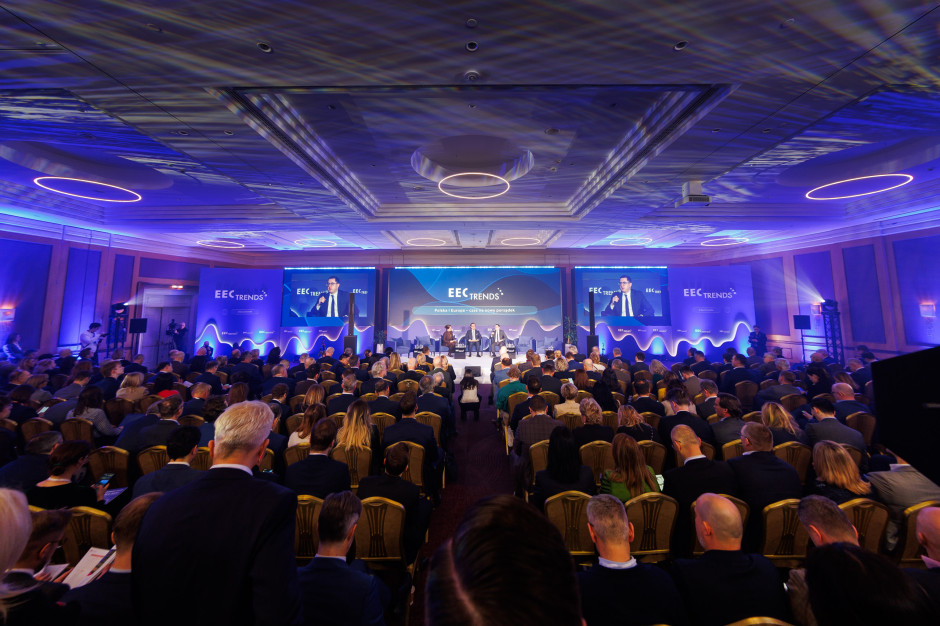
This year, the event attracted key representatives of business, government and politics, as well as experts and practitioners, who engaged in intense debates in order to define the role of Poland in a rapidly changing geopolitical and economic reality. The talks revolved around security and state resilience, economic competitiveness and conditions for investments, energy transition, development of technologies, and the labour market. The event was attended by more than 1,600 people, with 1,200 in-person attendees.
“EEC Trends is a place where we organize the most critical matters right ahead of the European Economic Congress. In our discussions, we concentrated on action in the field of security, investments, energy, and technologies that will allow Poland to maintain its rate of growth and build permanent competitive advantage in Europe,” says Wojciech Kuśpik, the president of the PTWP Group, the initiator and organizer of the European Economic Congress.
Honestly about Challenges
Talks between representatives of the Polish government were a great start to EEC Trends. The participants had an opportunity to hear the opinion of Minister of State Assets Wojciech Balczun, Minister of Energy Miłosz Motyka, and the Minister for Government Policy Implementation, Maciej Berek, Head of the Permanent Committee of the Council of Ministers.
Miłosz Motyka, responsible for Polish power industry, addressed the situation of Jastrzębska Spółka Węglowa S.A. and the recent talks with representatives of society. “I think that in the short term, the decisions made in 2023 were good. I mean the contracts of employment that were concluded for 10 years on very good terms. However, in the long term, the company was not prepared for the difficult time when the price of the raw materials has decreased, as a result losing several percent of its income, while its expenses have increased by several dozen percent. This is hardly long-term success,” Miłosz Motyka observes. The minister of energy has also said that the energy policy of Poland assumes that by the year 2040 the country will have commissioned a large nuclear power plant, small nuclear reactors, and renewable energy sources. This mix is supposed to offer cheaper prices of energy for the economy.
On the other hand, Minister of State Assets Wojciech Balczun announced fundamental changes in state-owned companies. “It is a response to what happened in state-owned companies during the previous cabinet term. Unfortunately, many of the decisions made by the previous government were against a sense of business decency and anything but professional,” the minister concluded. He also added that, after publishing the Code of Good Practice, the ministry will set ownership guidelines for all companies under its jurisdiction. Our aim is to create diverse teams consisting of lawyers, economists, financiers and experts with experience in each relevant industry. Competencies will be the critical criterion,” Wojciech Balczun insists.
At EEC Trends, the subject of deregulation led to a discussion about the quality of government. Maciej Berek, in the cabinet responsible for, among other things, deregulation, highlighted that, in order to be effective, the state cannot compromise between response time and reliable legislation; quick decisions must be accurate, while consistency in implementation and monitoring the effects of legislation at a later stage are key. He also observed that, so far, deregulation has been in the form of singular corrections, while the next stage will involve systemic changes, especially in the field of taxes and the judiciary. “I wish we stopped associating deregulation with removing barriers. Instead, we should view it as a change in the thinking of civil servants and politicians responsible for writing law. Deregulation is not merely removing what is already there, but it should also not enact overregulation,” noted Maciej Berek.
The opening session titled Poland and Europe – Time for New Order initiated debate on the economy in a time of geopolitical reconstruction, between chaos and looking for a new centre of balance. The participants discussed the possibility of achieving security, independence and resilience, without compromising economic growth and competitiveness, amid superpower rivalry, war, migration and other future crises. The point of reference in the discussion were the ambitions of Poland – including the significance of its promotion to the economic elite of the world – and new possibilities for business: investments, foreign expansion, digitalisation, and the role of Poland as Europe's manufacturing base and a potential hub for Ukraine.
Marta Postuła, first Vice-President of Bank Gospodarstwa Krajowego, highlighted the bank’s role as a stabiliser and driver for growth. “We are a belt conveying funds for the economy, a catalyst of solutions. We compete with other EU member states for providing funds for foreign expansion of Polish companies, e.g. investments in the IT sector in Africa,” she said.
Agnieszka Kubera, President of the Management Board at Accenture also spoke about the role and position of Poland on European and global markets. “The pace of investments and decision-making is a problem. Right now, we are learning how to invest in innovations, be ahead of the game, and become a leader in any given field. However, the productivity growth rate of the Polish economy is a positive sign. Now, we need to make sure that Polish companies make it to the global elite. We have the potential, competencies and resources. And we must promote knowledge-based solutions. There are successful Polish start-ups but not in Poland. We should provide them with an environment that would increase their chance of achieving success,” she insisted.
Michał Bolesławski, President of ING Bank Śląski, shared his views on whether the financial sector is optimally fulfilling its pro-development role in the economy and what conditions influence this. “Yes, there is room for greater involvement. We are able to finance more investments than we currently do. On the private sector side, however, there is a lack of willingness to take risks. The level of investment remains insufficient from the perspective of the economy. This is influenced by the regulatory environment, the predictability of the legal framework, as well as demographic trends and succession challenges within companies. As society becomes wealthier and older, risk tolerance does not increase,” he stressed.
What, then, is the share and role of Polish business in shaping Poland’s position on the international stage? Michał Wypychewicz, CEO of Koronea Family Office and Chairman of the Supervisory Board of ZPUE, commented:
“Polish politicians have already realized that the private sector is a source of strength for the Polish economy, and I am pleased that we have embarked on a path of dialogue,” he emphasized. “It is important that this dialogue be based on trust and mutual respect. Business must also understand the conditions under which politicians operate,” he concluded.
Secure Cyberspace
During the panel Digital, Sovereign, Secure, cybersecurity and technological sovereignty were presented as lasting foundations of state and economic stability. Krzysztof Gawkowski, Deputy Prime Minister and Minister of Digital Affairs, emphasized that security is increasingly determined by supply chains and real control over technology — including the hardware and infrastructure on which data is processed. He announced record levels of spending on cybersecurity in 2026, as well as investments in digital competencies, AI development, data centres, and large-scale implementation of public services within the mObywatel application. Among the plans, he also pointed to the implementation of the European Digital Identity Wallet, which is intended, among other things, to enable age verification for users of social media platforms.
“Technological sovereignty is linked to two aspects. First, the supply chain, and second, a strong technology sector. Hardware has nationality and can determine whether something is secure. It is the hardware that ultimately decides whether the data stored on it leaks to places where it should not,” he said.
Transformation as a Driver of Positive Change
During the debate Energy, Transformation, Economy, Wanda Buk, advisor to the President of Poland, confirmed that companies should operate with a lower WACC (Weighted Average Cost of Capital), as proposed in the President’s draft initiative. However, representatives of the largest energy groups do not share this view.
Wojciech Wrochna, Government Plenipotentiary and Deputy Minister of Energy, pointed to a certain paradox: energy prices in the country are already high, yet investment needs remain enormous. Further billions of zlotys must be spent on new generation capacity, among other priorities — and this will inevitably translate into higher final prices on consumers’ bills. “Where we are today is also the result of what we failed to do over the past decades. The Polish economy cannot afford further delays,” the government representative argued.
Wanda Buk returned to the President’s proposal to limit the rate of return on electricity distribution, arguing that this could help reduce prices for end consumers. In her view, Polish companies record the highest return on invested capital in the European Union (over 11%), compared with 4–5% in countries such as Germany or Denmark.
“These enormous profit margins recorded by distribution companies are not being reinvested in the grid; instead, they are paid out to parent companies in the form of dividends. Rationalizing this rate of return (…) to around 7% would realistically translate into lower prices,” the presidential advisor said.
Bartosz Krysta, Member of the Management Board for Commercial Affairs at Enea Group, disagreed with this position. “The cost of capital (WACC) in Poland is higher due to country risk and interest rates. Reducing the return on capital in distribution to below 7% would undermine the ability to invest,” he said.
Grzegorz Lot, President of the Management Board at TAURON Polska Energia, estimated that lowering the WACC from 9% to 7% would generate savings of around PLN 30 per year for an individual customer.
“Tauron has several billion zlotys in debt precisely because of its investments, and intra-group dividends are merely a cash management mechanism,” he assured.
The Global Importance of Local Content
During the Local Content in Energy session, expert discussions focused on practically increasing the participation of Polish companies in major energy investments — ensuring that economic and skill-related benefits remain in the country while solutions comply with EU regulations.
“By the end of February, a definition of local content should be ready,” clarified Ilona Deręgowska, Vice President of the Industrial Development Agency.
The participants emphasized that a higher share of domestic entities not only enhances the security of investment execution (reducing logistical and supply risks) but also provides opportunities to build new operational and manufacturing competencies within Polish companies. In this context, inter-ministerial work was also highlighted, including the team responsible for the national component tasked with creating conditions for Polish companies to effectively participate in supply chains and contracts for strategically significant projects, such as nuclear energy.
Infrastructure Investments as a Field of Strategic Decisions
The debate on major infrastructure projects was opened by minister Dariusz Klimczak, who stated that the investment process, both in Poland and across the European Union, would be simpler if the coordination between the state and the companies involved in project design, execution, and financing were even more efficient.
“When talking about large infrastructure projects, it must be clearly stated that they need to be implemented faster, with less bureaucracy, and regulations must continuously evolve. If we want to give the Polish economy a boost, investments need to be executed more quickly. In roads, rail, and aviation, we must not only find funding for major projects but, above all, the simplest possible regulations,” said Dariusz Klimczak, emphasizing the need to “sweep away unnecessary bureaucracy.”
The program also included debates on public investment, security, resilience, industry, resilient infrastructure, and demographics. The conclusions drawn from these discussions will serve as a foundation for the debates at the European Economic Congress.
Final Gala
The evening session of EEC Trends featured the prestigious WNP Awards gala — honouring individuals, institutions, and companies that are actively shaping the direction of the Polish economy. Statuettes were awarded to: Atlas Ward Polska, Beyond.pl, Cognor and Elemental, Grupa WB KUKE and Bank Gospodarstwa Krajowego, the mObywatel application, SEEN Technologie, Grupa TAURON, Trigon and Quercus.