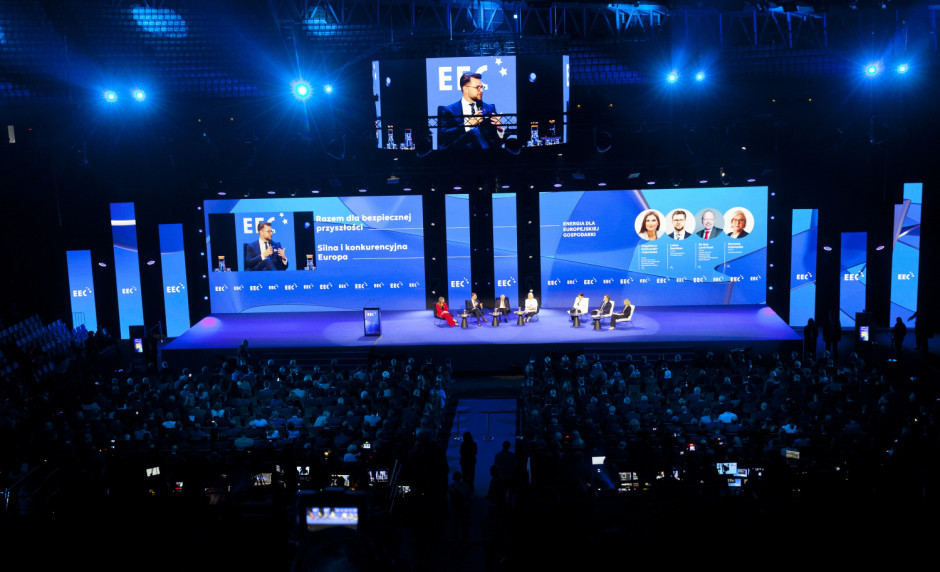
The agenda includes the most topical subjects of strategic importance, such Europe’s geopolitical agency, sovereignty, and the competitiveness of European economy, resilience, security and energy transition, as well as subjects concerning technological advancement, investments, local content, labour market, demographics and the impact of the younger generation on our shared future.
“For years, the European Economic Congress has provided a platform for conversation that offers more than a mere commentary to reality, concentrating on factors that determine the future of the economy. “Today, dialogue beyond sectoral and institutional divides is more important an ever. It is the only way can we responsibly discuss Europe’s competitiveness, security, energy transition, technologies, and investments. The agenda of this year’s edition of the event demonstrates the scale and complexity of challenges. It also draws the attention to the need for joint reflection on the solutions the impact of which will be felt here and now as well as in a long-term perspective,” says Wojciech Kuśpik, president of the PTWP Group, initiator and organiser of the European Economic Congress.
For years people have been a key asset of the European Economic Congress: business leaders, representatives of administration, pundits, academics, local politicians and practitioners representing various sectors. We already know the speakers who will bring to the table their knowledge and experience gathered through their contribution to society and economy.
Among others, the following have confirmed their participation in the event: Willemijn Aerdts, minister of digital economy and digital sovereignty of the Kingdom of the Netherlands; Bartłomiej Babuśka, president of the Industrial Development Agency; Wojciech Balczun, minister of state assets; Michał Baranowski, undersecretary of state in the Ministry of Development and Technology; Bogdan Benczak, president of the management board at PZU; Tadeusz Białek, president of the management board at the Association of Polish Banks; Michał Bolesławski, president of the management board at ING Bank Śląski; Rafał Brzoska, founder, president of the management board at InPost; Andrzej Domański, minister of finance and the economy; Joao Brás Jorge, president of the management board at Bank Millennium; Mark Brzezinski, former ambassador of the United States of America to Poland, member of the Council of Strategic Advisers UNIMOT; Łukasz Chaberski, president of the management board at Polskie Porty Lotnicze S.A. (Polish Airports); Mirosław Czekaj, president of the management board at Bank Gospodarstwa Krajowego; Krzysztof Gawkowski,deputy prime minister, minister of digital affairs; Przemysław Gdański, president of the management board at BNP Paribas; Marek Gzik, secretary of state in the ministry of science and higher education; Wiktor Janicki, president of the management board at the Employers' Union of Innovative Pharmaceutical Companies INFARMA; Katarzyna Anna Kacperczyk, undersecretary of state at the Ministry of Health; Michał Kobosko, Member of the European Parliament; Przemysław Koperski, undersecretary of state at the Ministry of Infrastructure; Katarzyna Kotula, minister of equality; Sebastian Kulczyk, international investor, owner of Kulczyk Investments, Manta Ray vc, Pho3nix Foundation; Maciej Lasek, secretary of state at the Ministry of Infrastructure, plenipotentiary of the government for CPK; Katrin Gülden Le Maire, expert in ethics in AI, strategic adviser; Grzegorz Lot, president of the management board at Tauron Polska Energia; Janusz Malinowski, president of the management board at PKP Intercity; Harlan Mandel, CEO Media Development Investment Fund; Adam Mokrysz, president of the management board at Mokate; Szymon Midera, president of the management board at PKO Bank Polski; Krzysztof Niemiec, vice-president of the management board at Track Tec; Piotr Okurowski, president of the management board at Kaucja.pl – the National Deposit and Return System; Mateusz Oleksy, director at Visa Poland; Remigiusz Paszkiewicz, president of the management board at KGHM Polska Miedź; Krzysztof Pawiński, president of the management board at Grupa Maspex; Katarzyna Pełczyńska-Nałęcz, minister of funds and regional policy; Nathan Reich, director, energy attaché, department of energy at the Embassy of the United States in Warsaw; Johan S. Roos, professor Peter Drucker Society Europe, Board Advisor Hult International Business School; Tomasz Rożek, founder and president of the management board at Fundacja Nauka. To Lubię (The “Science. I Like It” Foundation); Agnieszka Sarkowicz, president of the management board at Synthos AGRO; Henrik von Scheel, professor of strategic management and economy, strategist, futurist; Hannes Schreiber, ambassador of the Republic of Austria to Poland; Magdalena Sobkowiak-Czarnecka, plenipotentiary of the government for the Instrument for Security Action for Europe, the Chancellery of the Prime Minister; Rafał Sonik, president of the management board at Gemini Holding; Jan Sechter, deputy minister of trade and industry of the Czech Republic; Guy Standing, economist, professor of the SOAS University in London; Michał Wypychewicz, CEO, Koronea Family Office, chairman of the supervisory board at ZPUE and Piotr Żabski, president of the management board at Alior Bank.
The current list of speakers is available at https://www.eecpoland.eu/2026/pl/prelegenci/
What matters most
The programme of the 18th European Economic Congress has been designed to address both issues of strategic importance for Europe and its economy, as well as topics that directly shape the decisions of companies, institutions and local authorities. It is built on the organisers’ conviction that the most valuable insights and recommendations emerge at the intersection of diverse perspectives.
Europe, geopolitics and the security of the community
This year’s agenda is firmly anchored in questions about Europe’s position in a world of intensifying political, economic and technological rivalry. The debate will focus on the European Union’s geopolitical agency, the limits of European solidarity, the role of Poland and the wider region in the emerging political and economic architecture, as well as issues related to security, state resilience and collective responses to crises. In this context, the economy is not viewed in isolation from the international environment, but as one of the key foundations of Europe’s capacity to act, its stability, and its ability to operate under conditions of growing uncertainty.
Economic competitiveness, industry and investment
A significant part of the programme will be devoted to discussions on Europe’s and Poland’s competitive advantages, strengthening independence in key sectors, and enhancing economic competitiveness in a world of disrupted supply chains and rising trade tensions. The agenda covers topics related to industry, investment, exports, international economic cooperation, finance and management, as well as nearshoring, automation and innovation as drivers of growth. This is also the part of the debate where a central question emerges: how to reconcile modernisation ambitions with the real conditions of doing business and long-term economic security.
Energy transition, climate and the environment
One of the central themes of this year’s Congress is the energy transition, understood not only as a technological or regulatory process, but also as an investment in independence, resilience and long-term economic competitiveness. The programme includes discussions on the new energy landscape – including renewable energy sources, nuclear power, energy storage and flexible systems – as well as issues related to energy costs, infrastructure transformation, climate and the environment. Framed in this way, the agenda highlights that the transformation of the economic model is now inseparably linked with resource security, efficiency, environmental responsibility and the capacity to pursue long-term development policies.
Technology, digitalisation and new models of growth
Technology, data and digital transformation will also form a strong thematic pillar of the Congress, seen as one of the key foundations of a modern economy. The agenda includes topics such as artificial intelligence, automation, robotics, cybersecurity, the digitalisation of industry, energy and public administration, as well as the impact of technology on the labour market and skills of the future. At the same time, the Congress raises questions not only about the pace of change, but also about its implications for management models, productivity, education, and the ability of states and businesses to build sustainable competitive advantages in a knowledge-based economy.
People, public services and the social dimension of transformation
The EEC 2026 programme also clearly emphasises that economic and technological change cannot be analysed solely through the lens of growth indicators, investment or productivity. This is why it gives significant attention to issues such as the labour market, education, healthcare, local government, quality of life, demographics, migration and social cohesion. Complementing this perspective are thematic tracks dedicated to trade, media and communication, culture, lifestyle and the food industry. This broad approach confirms that the European Economic Congress remains a platform for dialogue not only about the economy in the strict sense, but also about the conditions for social development and the quality of institutions on which the sustainability of the entire transformation process depends.
Accompanying events
Accompanying events remain an integral part of the European Economic Congress, highlighting the practical dimension of development, entrepreneurship and cross-sector cooperation. The programme includes the Investor Without Borders 2026 Gala, during which awards will be presented in the categories of Foreign Investor in Poland and Polish Investor Abroad. The 15th anniversary edition of Top Investments 2026 will also take place, showcasing the most interesting and inspiring projects implemented by local governments across Poland. The programme will be further enriched by the EEC Startup Challenge 2026, culminating in an awards ceremony recognising the competition’s best startups.
The European Economic Congress will once again be held at the International Congress Centre and the Spodek Arena in Katowice, as well as in the Green Planet zone arranged between the two venues. Additional spaces will allow for a greater number of debates and will provide an ideal setting for networking among participants. The organisers expect well over ten thousand attendees, including over 1,300 speakers.
Registration for the event is now open:
https://www.eecpoland.eu/2026/pl/rejestracja,4759/